Austin Indoor Air Guide  /

Cedar Fever or Mold?

Is It Cedar Fever or Mold in Your Home? The Austin Guide to Distinguishing Allergies from Mold.

Every year around January, Austin fills with sneezing and watery eyes. But if your symptoms never fully clear, even indoors, even after allergy season, the culprit may not be cedar. It may be your home.

Cedar fever symptoms typically appear outdoors during Austin's winter pollen season (December–February). Mold exposure symptoms often persist year-round and worsen inside specific rooms. If your antihistamine stops working after allergy season ends, your home may deserve a closer look.

Cedar Fever vs. Mold Exposure: The Key Differences

Austin's Mountain Cedar (Ashe juniper) releases pollen in enormous clouds from late December through February. Mold is different — it grows indoors, releases spores year-round, and causes symptoms that are easy to misread as seasonal allergies.
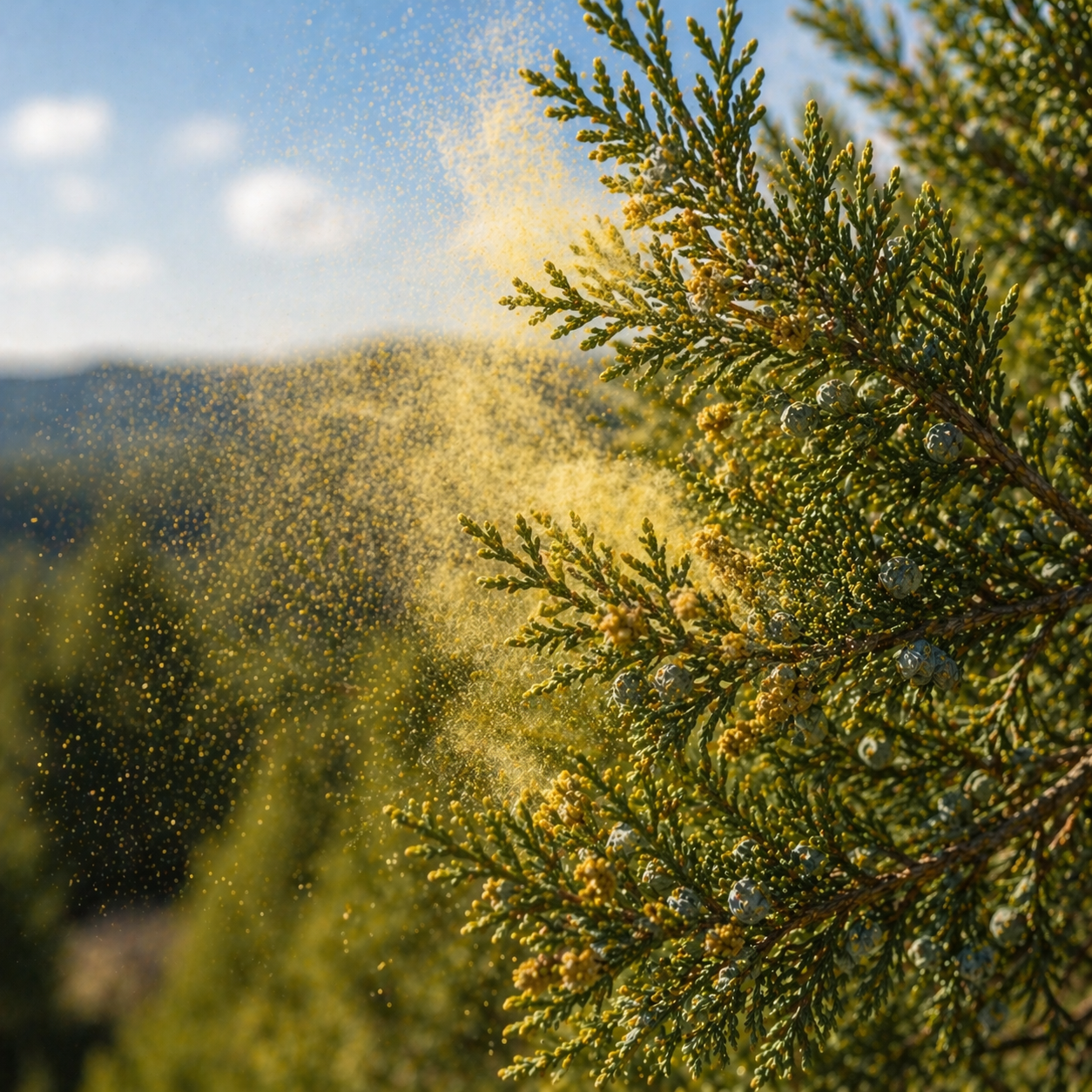
Cedar Fever
Seasonal. Predictable. Treatable.
Triggered by Ashe juniper pollen December–February. Responds to antihistamines. Improves when pollen counts drop or after heavy rain clears the air.
Indoor Mold
Year-round. Hidden. Often mistaken.
Grows inside walls, crawl spaces, and HVAC systems. Persists through every season. Symptoms worsen indoors and often resist allergy medication.
Factor Cedar Fever Mold Exposure
When it occurs Seasonal
December – February primarily
Year-round
Any time, any season
Where symptoms appear Outdoors, after time outside Indoors, often in specific rooms
Response to medication Antihistamines typically help Often resistant to allergy meds
Pattern Improves when pollen counts drop Worse after rain; persists indoors
Key symptoms Sneezing, runny nose, itchy eyes Congestion, fatigue, headaches, fog
Travel test Follows you if cedar counts are high Improves when away from home 24–48 hrs
Cognitive effects Rare Possible — mycotoxins in some molds

Why Mold Is a Year-Round Risk in Austin Homes

Cedar fever gets most of the attention, but Austin’s periodic high humidity, especially in warmer months, can also create conditions that support indoor mold growth when moisture isn’t well controlled.

Austin's proximity to Lady Bird Lake and Barton Creek contributes to elevated local humidity year-round.

Austin's Humidity Creates Ideal Mold Conditions

Indoor mold growth risk increases when relative humidity stays above 60%. During Austin’s more humid months, homes that don’t adequately control moisture can spend extended periods in this range, allowing humidity to accumulate in hidden areas like wall cavities, flooring, and HVAC systems.

The Lady Bird Lake Effect

Austin’s network of lakes and creeks—including Lady Bird Lake, Barton Creek, Lake Austin, and Lake Travis—can create small pockets of higher localized humidity near the water. However, indoor moisture and mold risk are driven far more by how a home manages humidity than by proximity to these waterways.

Mycotoxins and Cognitive Symptoms

Not all mold is the same. Some species found in water-damaged homes release compounds known as mycotoxins. Exposure has been associated with symptoms such as persistent fatigue, headaches, and difficulty concentrating, sometimes described as "brain fog." These cognitive symptoms are not typically associated with cedar fever, and can be a meaningful indicator that the issue is environmental, not seasonal.

If you're reaching for allergy medication in July — four months after cedar season ended — it may be worth asking whether the problem is still outside.

The Pier-and-Beam Problem in Older Austin Homes

Many of Austin's most desirable neighborhoods feature historic bungalows built on pier-and-beam foundations. These crawl spaces were common construction in Central Texas before slab foundations became standard — and they present a specific mold risk: without effective vapor barriers, ground moisture can migrate upward into floor joists and subflooring, creating hidden mold colonies that residents may never see, but often smell.

Pier-and-beam foundations common in central Austin neighborhoods can trap ground moisture without proper vapor barriers.

These neighborhoods have a significant concentration of pier-and-beam housing stock where crawl space moisture assessment is particularly relevant:

  • Hyde Park
  • East Austin
  • Tarrytown
  • Travis Heights
  • Clarksville
  • Cherrywood
  • Rosedale
  • Bouldin Creek
  • South Congress

How Your AC Unit May Be Spreading the Problem

Austin air conditioners run for the better part of ten months a year. This continuous operation means HVAC coils accumulate condensation, and when drainage is imperfect, moisture creates ideal conditions for mold inside the air handler itself — which the system then distributes to every room.

Dirty Sock Syndrome

When AC coils develop mold, the system's airflow carries spores throughout every room. A musty smell at startup is an early warning sign.

Whole-Home Distribution

Unlike a visible mold patch in a bathroom, HVAC-based mold actively distributes spores to every room it serves, all day long.

Thermal Imaging

Infrared cameras detect moisture behind walls and inside ductwork — problems invisible to the naked eye or a standard home inspection.

Laboratory Air Sampling

Spore counts from air samples reveal what's actually in your breathing air — not just what's visible on surfaces or detectable by smell.
Thermal imaging can identify moisture accumulation inside walls and ductwork long before visible signs appear.

Signs Your Home May Have Hidden Mold

If any of these apply to your situation, a professional assessment may be worth considering.

  • Your symptoms improve noticeably when you leave the house for 24–48 hours such as for work travel, vacation, or visiting family
  • You notice a musty odor after heavy rain
  • You have visible spots on ceilings, drywall, around window frames, or near HVAC vents
  • Your AC smells damp or musty when the system first turns on
  • You live in a pier-and-beam home and have never had the crawl space inspected
  • Your home has experienced any water intrusion such as flooding, a leaking pipe or a roof leak
  • Symptoms are worse in specific rooms (bathroom, kitchen, closet)
  • You've been treating "allergies" for months with only partial relief from medication

Concerned Mold May Be Affecting Your Home Environment?

A professional inspection can identify hidden moisture problems and potential mold sources. So you can have clear documentation of environmental conditions in your home.
Schedule Mold Inspection
  • TDLR Licensed Mold Assessors
  • Inspection-only — we never remediate
  • 100% unbiased reporting‍

Frequently Asked Questions

Can mold cause allergy symptoms similar to cedar fever?
Yes. Mold spores can trigger respiratory responses that closely resemble seasonal allergy symptoms: runny nose, congestion, sneezing, and itchy eyes. The key distinguishing factor is pattern. Mold-related symptoms tend to be persistent, year-round, and may worsen in damp conditions or in specific areas of a home, whereas cedar fever is closely tied to Austin's December–February pollen season.
Why are mold problems more common in Austin homes than in other cities?
Several Austin-specific factors contribute. The city's subtropical humidity creates prolonged periods of elevated indoor moisture. The prevalence of pier-and-beam foundations in older central Austin neighborhoods creates crawl space moisture exposure. And Austin's frequent flash flooding introduces water intrusion that can accelerate mold growth if not promptly addressed. Combined with near-year-round AC use, Austin residents face more mold risk factors than most comparable cities.
Does mold grow faster in humid climates?
Yes, significantly. Mold requires a food source (organic materials like wood, drywall, or insulation), warmth, and moisture. In humid climates, the moisture condition is more consistently met, allowing mold colonies to establish and expand more readily. In Austin, indoor humidity levels frequently exceed the 60% threshold above which mold growth is commonly observed.
What is a TDLR-licensed mold assessor and why does it matter in Texas?
Texas is one of the few states with formal licensing requirements for mold professionals. The Texas Department of Licensing and Regulation (TDLR) oversees the certification of mold assessors and remediators under the Texas Mold Assessment and Remediation Rules. Hiring a TDLR-licensed assessor means your inspection follows state-mandated protocols. The report also holds legal weight for insurance, real estate transactions, or landlord disputes.
How long does it take for mold to start growing after water damage?
Under favorable conditions, which Austin's climate provides year-round, mold can begin to establish within 24 to 48 hours of water intrusion. This is why acting quickly after any flooding, leak, or water event is critical. If materials were wet for longer than two days without proper drying, a professional moisture assessment is advisable regardless of visible signs.